«Why this path instead of that one? Where does it lead, that it draws us with such force?
Which trees and which friends live beyond the horizon of these stones, in the distant miracle of warmth?
We have come here because it was already impossible to stay where we were.»
René Char
New Beginnings
Humans experience life through internal processes that have a huge influence on what we perceive as the visible world. They can be of many different types, intensities and durations, but they have in common that, as we go through them, we discover ourselves. We become aware of our lights and shadows, we learn how to live with them and unexpected emotions appear, which can sometimes be deeply uncomfortable. Far from running away, something pushes us to continue.
Although the birth of a cycle is often imperceptible –subtly, the transformation begins in us–, its death, on the other hand, is usually clear. We know this because our gaze extends from the past, where it all began, to the present and the future. We begin to observe everything that this process has generated and we see that it has placed us in a very different spot than when we entered.
So, from this new place, what emerges? We are ready to continue paths that we have begun and to let others die, but above all we are ready to open new ones. We act from a new framework. Some of the things we perceive speak to us in a completely different way: they now have another relief, another depth. And we enter into consonance with other people's processes from this new reality. Consonances that can occur simultaneously, or also through a time lapse that, at the sametime, seems to disappear. It is as if time did not exist anymore. It is as if it passed through us and united us all.
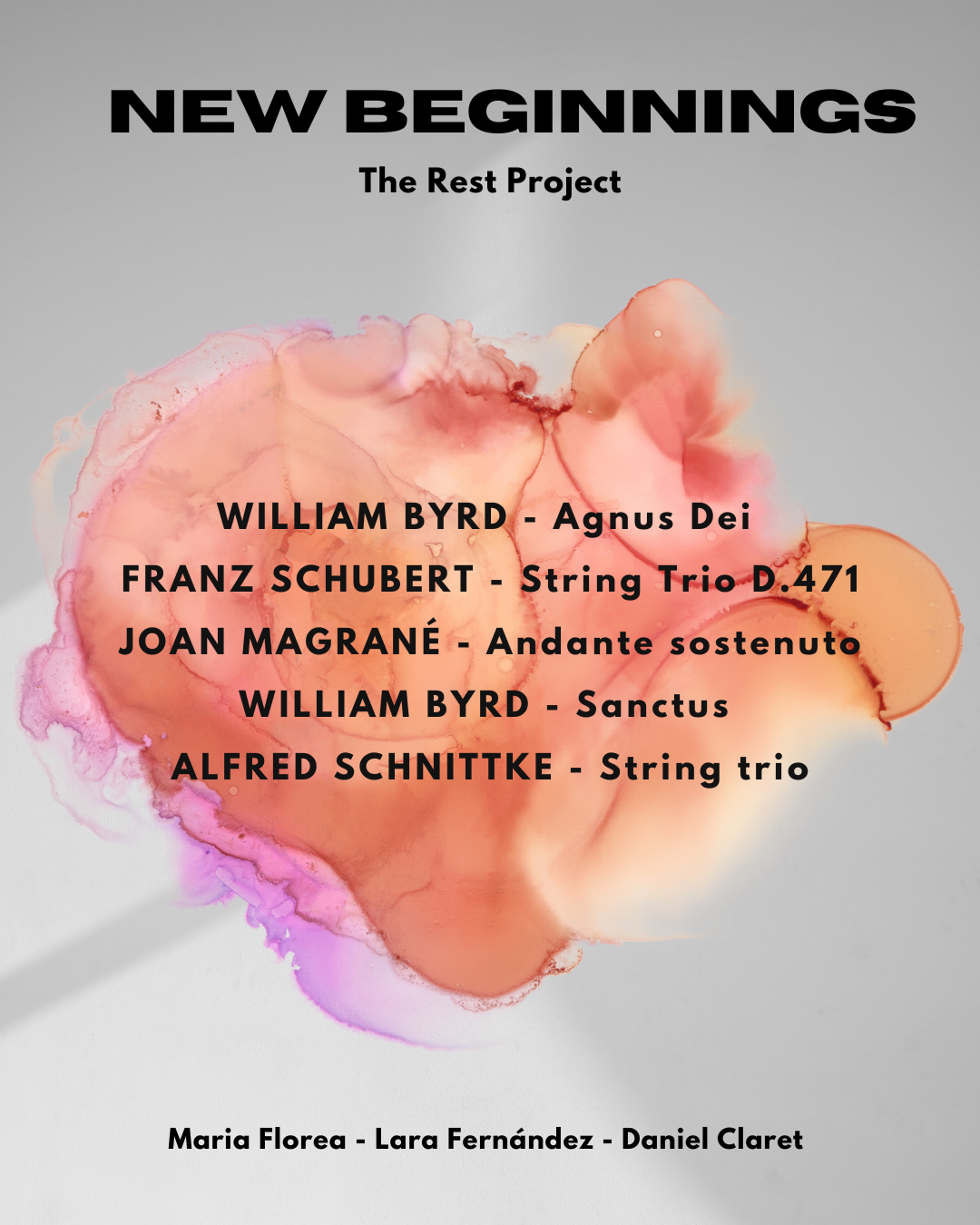
In 1816, Franz Schubert began to compose his trio D.471, and stopped after writing a few bars of the second movement. It was not the first time that he had left a work incomplete. It was not the time to continue. Joan Magrané was now inspired by this suspension and wrote his Andante sostenuto* to open a cycle aligned with the one Schubert left incomplete. Another composer imbued with the lyricism and form of the Viennese composer is Alfred Schinttke, who with his unmistakable style, turns his String Trio into an example of coexistence between Schubertian light and Schnittkeian shadow. Curiously, it also consists of two movements, these ones, completed. To close the triangulation —both geographical and spiritual— that surrounds Schubert, William Byrd contributes his mass for three voices. Composed almost clandestinely in 1592, it displays the purest vocality with which Schubert, Schnittke and Magrané connect, even more than four centuries later.
*premiere work co-commissioned by the Auditori de Barcelona and The Rest Project.